Ingest
Signals are collected continuously from official sources, agency feeds, transport operations data, and curated open-source intelligence. Inputs are normalised at the point of entry so downstream stages operate on consistent structure.
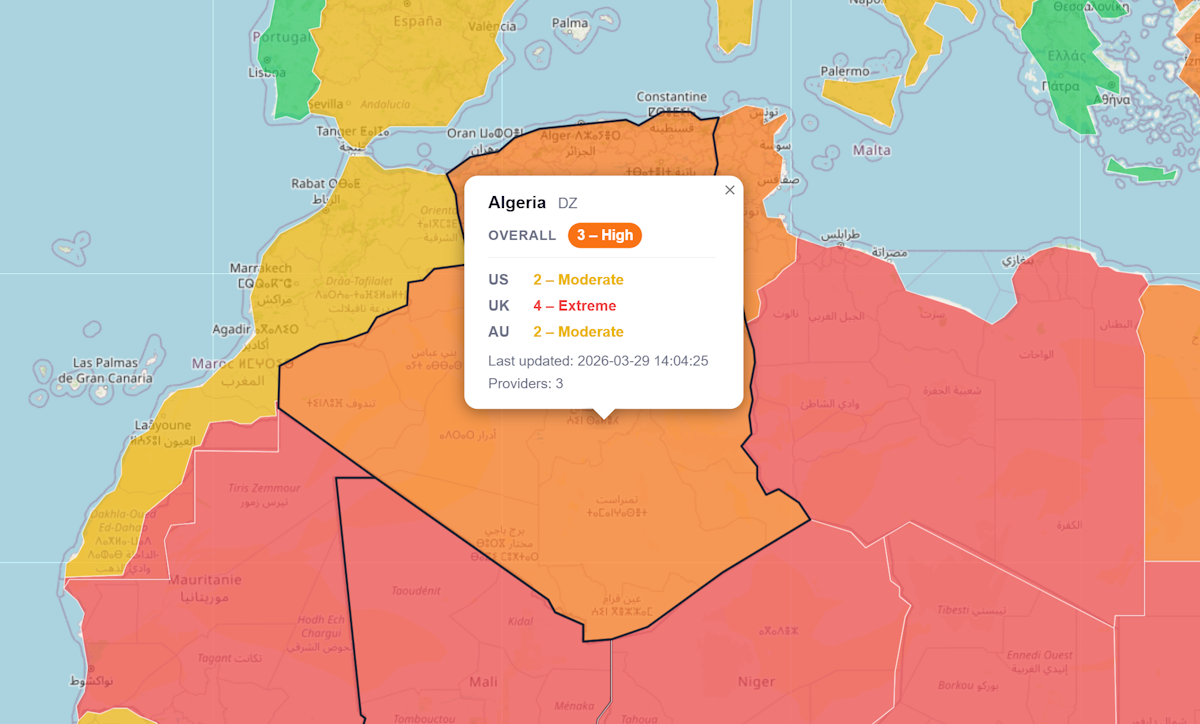
Voyage Risk is a standalone risk intelligence engine. It detects, verifies, geolocates, classifies, and publishes real-time risk alerts.
Consumed directly via REST API and webhooks, or alongside Voyage Manager for people context and workflow.
Five stages, from raw signal to published alert.
Signals are collected continuously from official sources, agency feeds, transport operations data, and curated open-source intelligence. Inputs are normalised at the point of entry so downstream stages operate on consistent structure.
AI corroborates incoming signals across sources, deduplicates near-duplicates, and tracks provenance. Every alert carries its source references so downstream systems can audit the basis for each record.
Each alert is resolved to a country and, where possible, to state or province, city, or GPS coordinates. Where the source input is ambiguous, that uncertainty is reflected in the geolocation confidence, not hidden.
Severity, category, and confidence are assigned to every record. Severity reflects potential operational impact. Category describes the type of event. Confidence reflects the pipeline's certainty in the classification and geolocation.
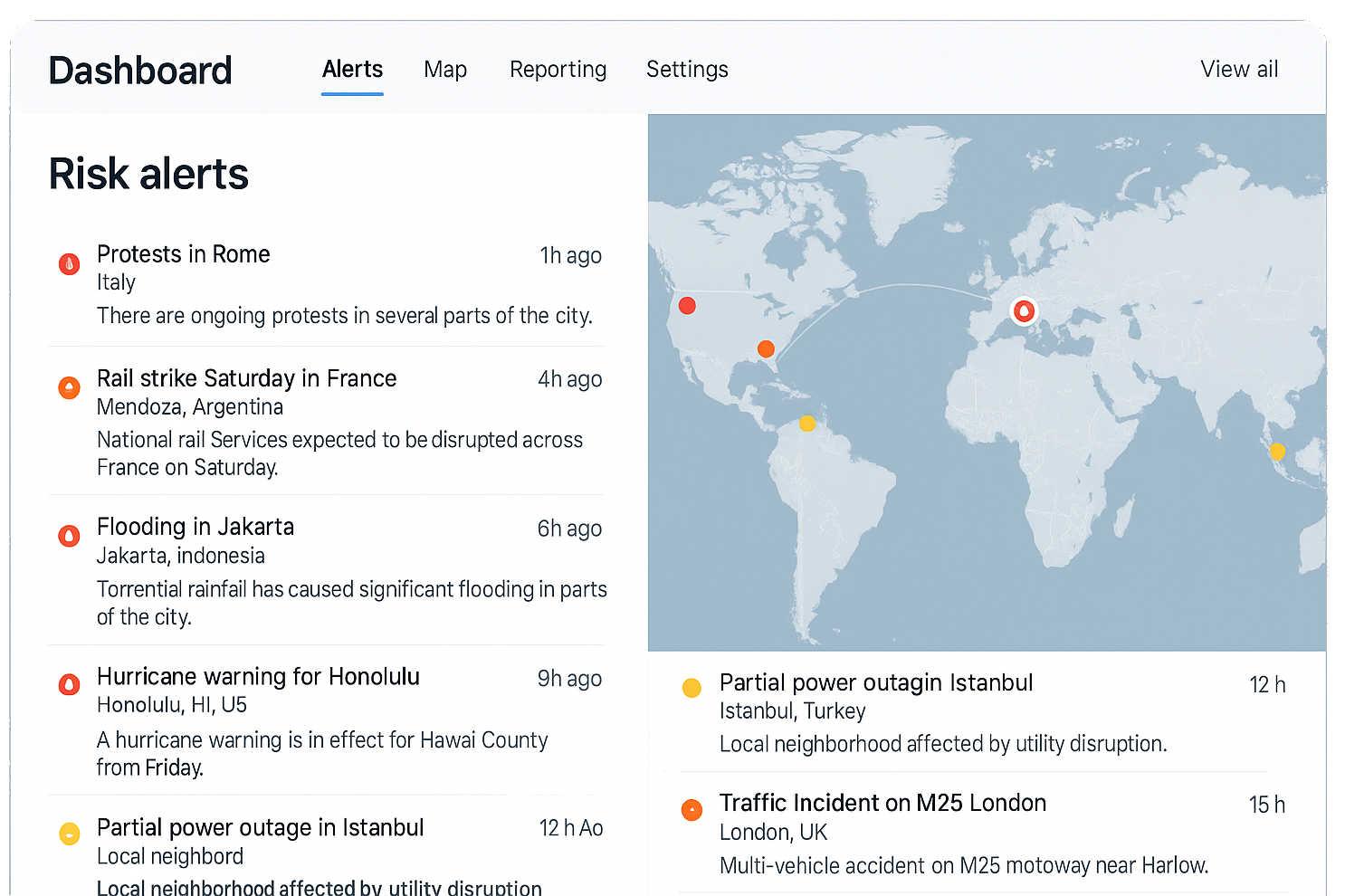
Published alerts are delivered in real time via REST API and webhooks, and are also available through Voyage Manager for customers who use it as their people-context and workflow layer.
Every published alert is a structured record with consistent fields:
Field-level schema documentation is shared with approved integration partners during onboarding. See the API page for developer-focused detail.
AE · Dubai · 25.2048, 55.2708
Heavy rainfall causing flooding and transport disruption.
{
"alertId": 67890,
"incidentId": 12345,
"incidentLocationId": 54321,
"feedName": "NWS",
"externalId": "nws-abc123",
"sourceUrl": "https://example.com",
"headline": "Severe weather disruption",
"description": "Heavy rainfall causing flooding and transport disruption.",
"category": "weather",
"severity": 3,
"country": "AE",
"stateOrProvince": null,
"city": "Dubai",
"locationLevel": "city",
"affectedCountries": ["United Arab Emirates"],
"affectedCountryCodes": ["AE"],
"latitude": 25.2048,
"longitude": 55.2708,
"occurredUtc": "2026-04-21T10:32:00Z",
"ingestedUtc": "2026-04-21T10:35:00Z"
}
Illustrative example. Not live data.
Alerts are available through the portal, the REST API, and webhooks. Dashboard and map views surface verified events with their geolocation context.
Voyage Risk is consumed standalone via REST API and webhooks, or used alongside Voyage Manager for people context and workflow.
Query alerts by country, severity, category, or time window. Clean, versioned JSON designed for automation.
Alerts pushed to your endpoint the moment they publish. Filter by country, severity, or category.
Use Voyage Manager for traveller and site context, geofencing, routing, acknowledgements, and workflow on top of Voyage Risk alerts.
Voyage Risk delivers the signal. Voyage Manager, where used, provides the people context, routing, and workflow.
A clear boundary between Voyage Risk and the rest of your stack.
Those capabilities live in Voyage Manager when customers use it, or in your own systems.
Request a live demo, or read the API documentation.